Your Builder's Move-In Date Is an Estimate, Your Contract Says So
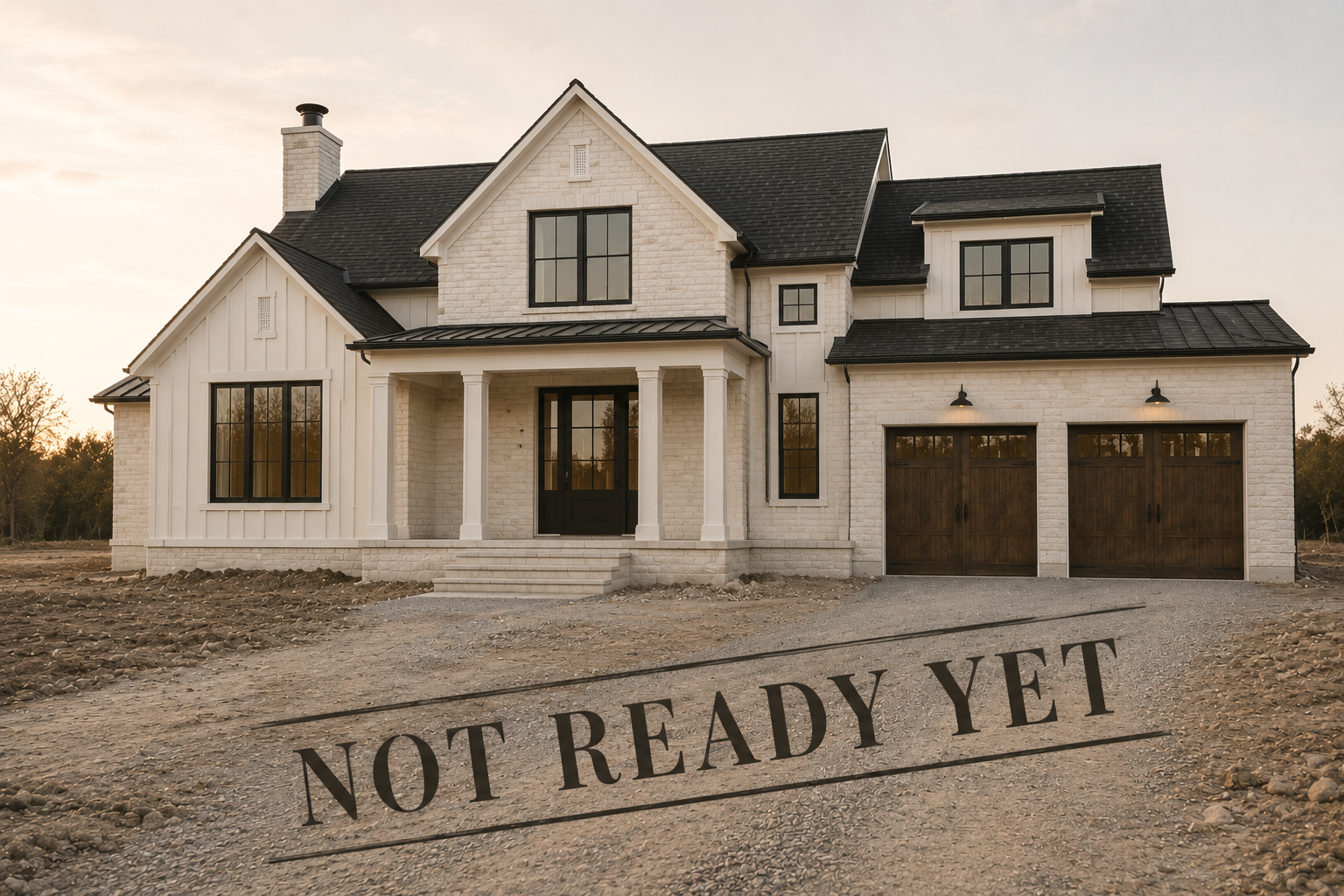
How This Goes Wrong
The builder gave you a date. You wrote it in your calendar, told your kids, called the movers, and listed your house.
Then the date moved.
This is one of the most financially damaging — and most preventable — mistakes buyers make during a custom build. It is not a rare edge case. Builders routinely cannot confirm a firm closing date until two weeks before it actually happens. The gap between the estimated completion date and the actual closing date is the window where buyers end up in extended-stay hotels, paying for two moves, and carrying costs they never budgeted for.
The problem is not that builders run late. The problem is that buyers treat an estimate like a contract date — and make irreversible financial decisions based on it.
From The Field
A couple building a custom home in the mid-Atlantic region planned their timeline carefully. Their builder projected an October completion. They listed their current home in August, sold it quickly, and arranged temporary housing through October — a 60-day buffer they thought was more than enough.
October came. The builder pushed the date to December. December came. The builder pushed again to late January.
By the time they closed on their new home, they had paid four months of temporary housing at $2,800 per month, two storage units at $350 per month each, and rescheduled movers twice — the second time at a premium rate because they needed availability on short notice. Their total out-of-pocket cost for the delay: just under $15,000. None of it was reimbursable under their contract.
What they wish they had known: their contract explicitly stated that the completion date was an estimate and that the builder was not financially liable for delays. That clause was in the third page of the agreement. They had not focused on it at signing.
What Went Wrong
The mistake was not selling their home. The mistake was timing the sale to the builder's estimated date rather than to verified construction progress.
Builder contracts are written to give builders scheduling flexibility. A standard residential construction contract typically includes language that reads similarly to this: "Any completion date contained in this agreement is the best estimate of when the new home will be completed and in no way is a guarantee." That clause is not unusual. It is the norm.
Beyond that disclaimer, most contracts allow the builder to extend the completion date multiple times — in some cases up to 120 days per extension with proper notice — without financial penalty. Force majeure clauses are broadly written to include weather, labor shortages, supply chain issues, and general unforeseen circumstances. The buyer bears all the financial consequences of those extensions. The builder bears none.
The assumption that cost this couple $15,000 was simple: they believed the date the builder gave them was something close to a commitment. It was not. It was a sales estimate.
My Take
Builders are not being dishonest when they give you an estimated completion date. They genuinely cannot predict the final weeks of a custom build that far in advance. Permit delays, inspection backlogs, subcontractor schedules, material lead times — any one of these can shift the final weeks of a project by 30 to 60 days.
The problem is that builders communicate estimated dates in the same tone and format as confirmed ones. A buyer hears "October" and naturally plans around October. The builder never said it was guaranteed. But they also did not make the uncertainty obvious.
What industry professionals understand — and buyers often discover too late — is that a closing date on new construction cannot realistically be confirmed until the builder receives a Certificate of Occupancy, and that cannot be issued until all inspections pass. That process alone can take weeks after the physical work is done. No builder can reliably predict that timeline six or eight months in advance.
The buyers who avoid this problem are the ones who ask specifically: what is the process for confirming a firm closing date, and how far in advance will I know? They also ask what the contract allows in terms of extensions — not as a worst-case scenario, but as a planning reality.
What To Do Instead
Before you sign the contract:
Ask your builder directly: "What triggers a confirmed closing date, and how far in advance will I receive that confirmation?"
Review the contract's delay clause carefully — how many extensions are permitted, how much notice is required, and what qualifies as an excusable delay
Ask whether the contract includes a per diem penalty for delays beyond a certain threshold, or negotiate to add one (see: Your Payment Schedule Is a Leverage Document. Most Buyers Never Negotiate It.)
Identify the contract's outside closing date — the date beyond which you may have the right to exit the agreement
When planning your home sale:
Do not list your current home until you are within 90 to 120 days of a confirmed completion window — not an estimate
Build a cash reserve for 60 to 90 days of temporary housing before you list; treat it as part of your build budget
Ask your builder for milestone updates at key construction phases — foundation, framing, drywall, final inspections — so you can track real progress rather than relying on a single date
Understand that verbal updates from your builder's project manager are not the same as contractual commitments
Warning signs:
A builder who cannot tell you what triggers a firm closing date
A contract with no limit on delay extensions
A builder who discourages questions about the schedule clause
Progress updates that arrive only when you ask for them
A buyer advocate reviews your contract's schedule language before you sign — not after you are already in temporary housing. They ask for milestone dates, not just a completion estimate. They help you time your home sale around verified construction progress, not a projected date on a sales sheet. (See: What Is a Custom Home Buyer Advocate and Why You Need One)
FAQ
Is my builder's completion date a legal commitment?
In most residential construction contracts, no. The completion date is typically stated as an estimate, and the contract language usually makes clear that it is not a guarantee. Always read the specific clause in your agreement before making plans around that date.
How far in advance will I know my actual closing date?
For most custom home builds, a firm closing date cannot be confirmed until the builder obtains a Certificate of Occupancy, which requires passing all final inspections. In practice, most buyers receive confirmed closing dates two to four weeks in advance — sometimes less.
How many times can a builder delay my closing?
This depends entirely on your contract. Some contracts allow unlimited extensions with proper notice. Others cap extensions at a certain number or total length. A few include an outside closing date that triggers buyer exit rights. Read your contract's delay provisions before you sign.
What costs should I budget for if my builder runs late?
Plan for temporary housing ($2,000-$4,000 per month depending on your market), storage ($200-$500 per month), and potential rescheduling fees if you need to move movers. A 60- to 90-day delay can cost $8,000-$15,000 out of pocket.
Can I negotiate schedule protections before signing?
Yes. Per diem penalty clauses — where the builder pays a daily fee for delays beyond a certain date — are negotiable in some contracts. Most buyers never ask. Asking is the first step. (See: Your Builder Says You Are On Budget. Are You?)
What if I have already listed my home and my builder delays?
Your options depend on your purchase contract and whether you have flexibility to extend your current home's closing. Talk to your real estate attorney immediately. Some buyers negotiate a rent-back from the buyer of their current home to buy additional time.
Key Takeaways
Your builder's projected move-in date is an estimate. Your contract almost certainly says so in writing.
Closing on new construction cannot be confirmed until the builder passes final inspections and receives a Certificate of Occupancy — a process that can take weeks.
A 60- to 90-day delay costs most buyers $8,000-$15,000 in temporary housing, storage, and moving expenses.
Do not list your current home until you are within 90 to 120 days of a confirmed completion window, not an estimated one.
Read your contract's delay clause before you sign — how many extensions are allowed, what qualifies as an excusable delay, and whether an outside closing date exists.
If you are heading into a custom build, the contract you sign at the start determines how much protection you have when timelines shift. Most buyers review the finishes and the price. Few review the schedule provisions. That gap is exactly what Foundation First was built to close.
Foundation First is a self-paced system built for custom-home buyers who want to know what to ask, what to watch for, and what to do before decisions get expensive. Whether you are still in the planning phase or already under contract, it gives you the knowledge to stay ahead of the process — not catch up to it. Learn more about Foundation First
Alanna
Plan Smart. Build Strong.
The Building Edit
Further reading
- Your Draw Schedule Is a Leverage Document
- What Is a Custom Home Buyer Advocate and Why You Need One
- Your Builder Says You Are On Budget. Are You?