Three Builders, Same Plan, Three Different Numbers: What You're Actually Comparing
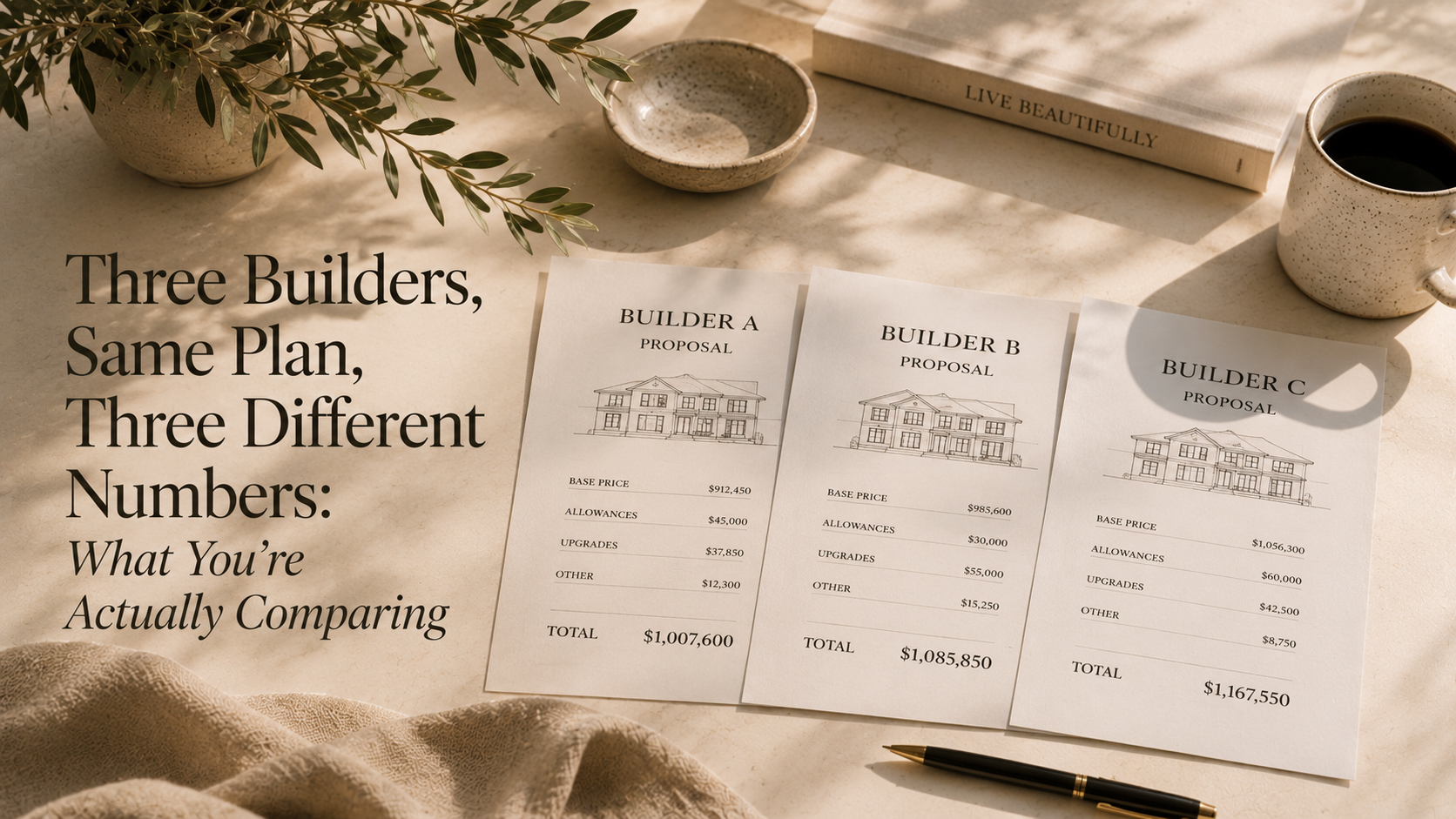
You found an architect, finalized a set of plans, and sent them to three builders. You asked for their best number. You received three bids. Now you're trying to figure out which one to choose.
Here's what nobody told you: you didn't receive three prices for the same home. You received three different interpretations of what that home is.
Why builder bids on the same plans diverge
Custom home plans describe the structure. They specify dimensions, room counts, and general layout.
What they almost never specify completely are the hundreds of decisions that determine what a home actually costs to build: the grade of windows, the depth of allowances for finishes, the quality of mechanical systems, what's included versus excluded, and how the builder's profit is structured into the price.
Every builder fills those gaps differently. And the gaps are large.
A custom builder documented a real example on their website: two bids on the same set of architect's plans, same house, same site. One builder quoted stock windows.
The other followed the architect's specifications and used custom-sized windows. The difference on that one line item alone was $100,000. Not the whole bid. One line item.
This isn't an anomaly. It's how bidding works when specifications aren't fully locked down before bids go out.
The allowance problem hidden inside every low bid
One of the most reliable ways a builder keeps a bid number low is by setting allowances at the floor rather than at the level the buyer actually intends to build. The flooring allowance covers $4 per square foot.
The lighting allowance covers builder-grade fixtures. The cabinet allowance covers stock, not custom.
None of this is disclosed in the total number. It's buried in line items that most buyers don't compare across bids because they're focused on the headline.
By the time the buyer discovers the gap, they've signed. And every dollar over allowance becomes a change order, which carries the builder's markup on top of the overage. A $12,000 flooring gap becomes $14,400 to $16,200 by the time the markup applies.
The lowest bid often becomes the most expensive home. Not because the builder was dishonest. Because the number was built on assumptions the buyer never had the chance to evaluate.
What builders don't show you: how profit is structured
Builder gross profit margins typically run 15 to 25 percent, according to NAHB data. But how that margin is built into the price varies significantly from builder to builder.
Some price it into a higher base number with generous allowances and minimal change order exposure. Others price it low upfront and recover margin through change orders, allowance overages, and upgrades during the build.
Both are legitimate business models. The buyer has no way to tell which model they're looking at from a total bid number alone.
A builder charging $350 per square foot with realistic allowances and a fixed-price contract is a different proposition than a builder charging $280 per square foot with tight allowances and a change order markup of 30 percent.
The second builder may end up costing significantly more. The number at bid time gives no indication of which scenario you're in.
From the field
Three bids came in on the same 3,800 square foot plan. The spread was $210,000 from lowest to highest. The buyer went with the lowest number, assuming the other two builders were simply more expensive.
Fourteen months later, the home closed at $187,000 over the original bid. The low bid had allowances set well below what the buyer's selections would require, a 28 percent change order markup written into the contract, and several line items excluded entirely that the buyer assumed were standard.
The highest original bid, reviewed after the fact, had included all of those items, carried realistic allowances, and would have finished near its original number. The buyer had compared a complete price to an incomplete one and chosen the incomplete one.
What to actually compare when evaluating builder bids
A total number is not a basis for comparison. What you need to compare is what each number includes. That requires asking every builder the same set of questions and putting the answers side by side.
Start with the base price. Ask each builder to confirm in writing what is included in the base price, not in general terms, but specifically. Is the garage included? Covered porch? Finished basement if applicable? Exterior grading?
These items are handled differently by different builders and can account for tens of thousands of dollars in the spread between bids.
Then go through the allowances line by line. Ask each builder to show you, using their current supplier's pricing, what the allowance amount actually buys right now. Not in general. Not approximately.
Pull up the catalog and show you. A $15,000 cabinet allowance that buys semi-custom at one builder and stock at another is not the same allowance. The number looks identical. The home does not.
Ask for the full exclusion list. Every builder has one. Items they won't do, items that require a separate contract, items that are assumed to be handled by the owner.
This list is where the real differences between bids often live. A builder who doesn't produce an exclusion list either doesn't have one or doesn't want you to see it.
Ask the change order markup percentage and confirm it applies to all changes, including builder-initiated field adjustments. This number is set at signing and applies for the life of the build.
On a $200,000 in change orders over a 14-month build, the difference between a 15 percent markup and a 28 percent markup is $26,000.
Finally, ask what the builder's average final cost variance has been on their last five completed projects. How much did those homes finish above or below the original bid?
A builder who tracks this and answers directly is showing you something. A builder who deflects or says every project is different is also showing you something.
Put those answers in a spreadsheet, not a mental tally. The bid that looks highest on paper sometimes looks very different when the allowances are realistic, the exclusions are minimal, and the change order markup is reasonable.
And the bid that looked lowest sometimes disappears entirely when you fill in what it was missing.
FAQ
Why do builder bids on the same house plans vary so much?
Because plans don't specify everything. Builders fill in the gaps differently, using different allowance levels, different spec grades, and different assumptions about what's included.
Two bids on the same plans can reflect completely different homes.
Is the lowest builder bid ever the best choice?
Not if the low number is built on unrealistic allowances or a high change order markup. A low bid that becomes a high build costs more than a higher bid that finishes near its number.
The bid to trust is the one that shows you exactly what it includes.
What is a builder's profit margin and does it affect my price?
Builder gross margins typically run 15 to 25 percent. How that margin is structured into the price matters. Some builders front-load it into a higher base price with complete specs.
Others build it in through change orders and allowance upgrades. The second approach is harder to see at bid time and often more expensive overall.
How do I compare builder bids fairly?
Ask each builder for a complete breakdown: base price inclusions, allowance amounts with examples of what they cover, full exclusion list, and change order markup percentage. Then compare line by line, not total to total.
What should I do before I send plans out for bids?
Specify as much as possible before bids go out. The more decisions locked down upfront, the less room for assumptions to diverge between bidders.
Finalize allowance categories and get current market pricing for your intended selections so you can evaluate whether each builder's numbers are realistic.
The free guide at thebuildingedit.com covers 7 of the most costly decisions custom home buyers make before signing, including what to look for in a builder bid before you commit to a number.
Plan Smart. Build Strong.
Alanna Gael
The Building Edit